The Challenge
Women environmental and human rights defenders (WEHRDs) and LGBTIQA+ activists have long worked at the intersection of gender, conflict, and climate justice, but policy and research frameworks have yet to fully reflect and integrate their contributions. While climate-nexus-thinking is gaining traction, it often remains fragmented, shaped by securitised narratives that overlook lived realities and deeper structural inequalities. Mainstream approaches frequently frame climate as a “threat multiplier,” reduce gender to a tick-box, and overlook how conflict shapes people’s capacity to adapt. Yet it is the knowledge and leadership of people working the land, community peacebuilders, and movement organisers that offer grounded, intersectional solutions essential for just and sustainable responses.
Our Approach
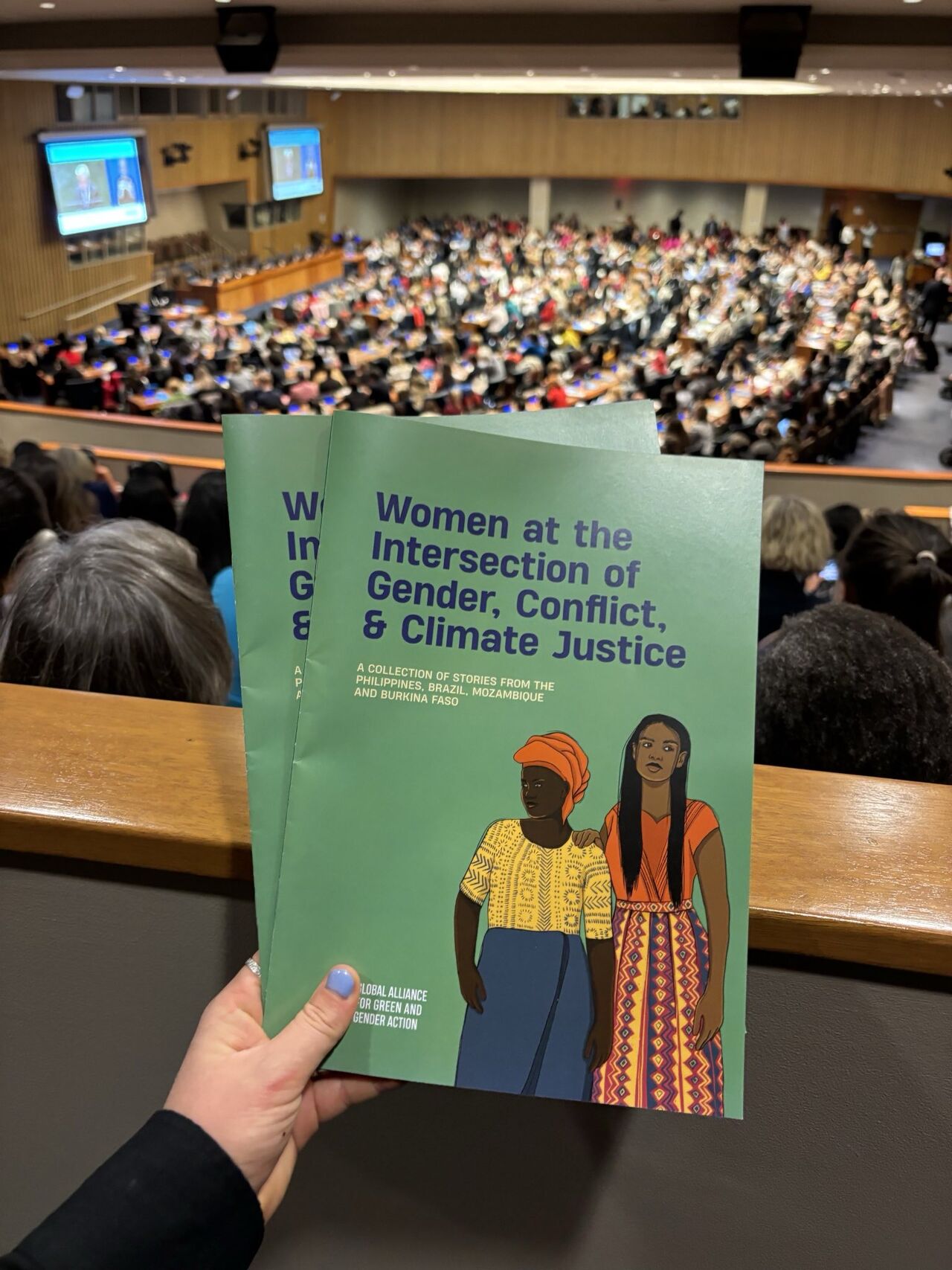
In partnership with the Global Alliance for Green and Gender Action (GAGGA), trans:verse led a feminist participatory case study analysis with women or LGBTIQA+ led community-based organizations and movements from Brazil, Burkina Faso, the Democratic Republic of the Congo (DRC), Mozambique, Nigeria, and the Philippines. Using feminist participatory action research grounded in a strong Do No harm approach, trans:verse created space for these partners to define the gender-conflict-climate nexus on their own terms and link their everyday struggles to global systems. Accompanying partners through the data collection process included targeted trainings and workshops, for example on risk assessment and mitigation, ethical visual representation and using the Kobo Toolbox to complement qualitative with quantitative data. Subsequently, we co-created a series of case studies capturing diverse insights into the linkages between gender, conflict and climate change. These included, for example, the impacts of extractivism and climate change in Nigeria and the DRC, Indigenous women’s resistance to militarisation and extractivism in the Philippines, and women’s use of dialogue and advocacy to defend land rights and promote climate change adaptation and mitigation in Mozambique.
The Results
The participatory process deepened partners’ understanding of the gender–conflict–climate nexus and strengthened their advocacy with donors and decision-makers. For GAGGA, the collaboration demonstrated that high-quality, context-responsive research can meaningfully advance feminist climate justice. As GAGGA reflected, “trans:verse showed remarkable flexibility, adapting research design, data collection, and workshops to shifting contexts while maintaining rigorous analysis that supported our partners and advocacy efforts.” This adaptability ensured the process remained relevant across diverse and often volatile contexts, while maintaining a strong focus on care and quality. LGBTIQA+ partners highlighted how being supported by researchers who shared their identities fostered trust and openness, enabling conversations that might not have been possible otherwise. As Déborah Sabará from Associação GOLD shared, “II didn’t have to explain things that even allies might not immediately understand. … I felt it was easy, natural, and deeply affirming to co-create with people who share such an important part of our identity.” Partners working in high-risk environments also valued the space to pause, reflect, and strategize collectively based on the data they generated. The resulting case studies now provide GAGGA and partners with a grounded, nuanced evidence base that informs advocacy rooted in lived experience. This collective analysis shaped GAGGA’s engagement at CSW69 and COP30, reinforcing a shared commitment to co-creating knowledge with care, rigor, and solidarity across movements and contexts. Read the full analysis and recommendations, policy brief and collection of stories!