The Challenge
Despite Côte d'Ivoire's strong economic growth, with a demographic growth rate of about 2.5% improving youth employment and income is one of the country’s major challenges. The vocational training programmes are insufficiently aligned with private sector needs. The labour marked is gender segregated, making it difficult for young women to enter professions which are seen as “masculine” but also hindering young men from pursuing careers which are seen as “feminine. On top of this, sexual harassment in the workplace is widespread, especially in the hotel sector.
Our Approach
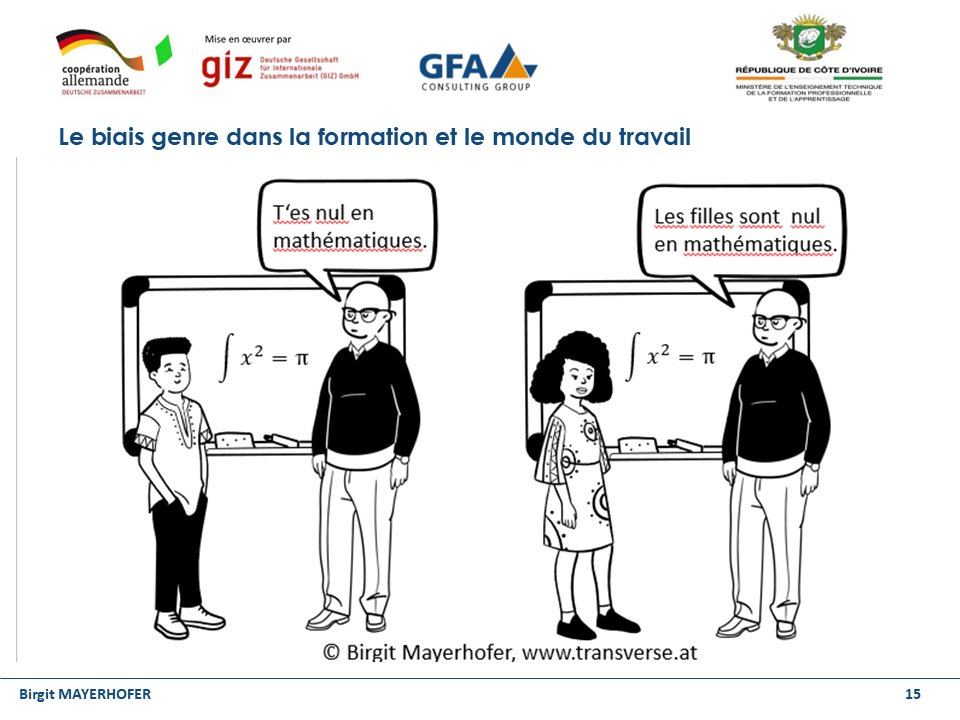
The dual vocational education approach, which involves splitting professional training between company-based and school-based settings, has become an important strategy to promote youth employability. Our client is assisting the Ivorian government in strengthening the institutional, legal, and human resource frameworks necessary for developing labor market oriented dual vocational training programs. In this initiative, trans:verse has integrated gender mainstreaming into the curricula and pedagogical guidelines for four apprenticeship professions. Additionally, we developed a comprehensive module on gender equality that covers essential topics such as balancing professional and family life, challenging gender stereotypes, and preventing sexual harassment in the workplace. To aid educators, an accompanying manual has been created to support teachers in effectively delivering this content. To encourage widespread adoption, we have conducted sensitization workshops for government and school officials, focusing particularly on strategies to combat sexual harassment. Furthermore, trainers of vocational teachers and vocational school teachers have received training on implementing the gender module, utilising interactive and gender-responsive teaching methods. Establishing functional complaints mechanisms for sexual harassment exceeded the available resources. Instead, trans:verse proposed a pilot project in four vocational schools. This project involves training counselling teachers to provide support to students who have experienced sexual harassment. These teachers will also support the newly established Girls’ Clubs within the schools. Additionally, trans:verse will organise workshops for advanced female students, focusing on empowerment, Sexual and Reproductive Health Rights (SRHR), and career development for women.
The Results
Policies need to be brought to life. Public servants and teachers can now apply approaches for gender-transformative vocational training. Their integration into teachers’ initial training supports the sustainability of the gender responsive curricula. Women’s empowerment forms part of our client's gender-transformative approach. Specifically trained counselling teachers will help to prevent and manage sexual harassment in vocational schools. Female students trained by trans:verse will become peer educators leading Girls' Clubs, training new students to become leaders the following year and providing ongoing support for girls in vocational training schools.